
Article summary
- An AI content pipeline should connect ideas, research, drafting, review, publishing and measurement.
- Automation works best on repeatable steps, while positioning, claims and final approval should stay under human control.
- A small business should start with one content type and one distribution channel before expanding.
- The pipeline should use measurable outcomes such as qualified traffic, inquiries and conversions rather than content volume alone.
Key takeaways
- Define the pipeline before choosing tools.
- Keep human approval for claims, tone and final publishing.
- Reuse structured inputs so AI output becomes more consistent.
- Measure whether content creates useful traffic and leads.
- Run a Market Scan before scaling content around weak positioning.
What an AI content pipeline actually is
An AI content pipeline is the full path from a content idea to something published and measurable. The keyword is pipeline. A prompt that generates a blog post is not yet a pipeline. A real workflow defines what information goes in, which steps can be automated, where human review happens, where content is published, and how performance is measured.
For a small business, this matters because inconsistent content usually comes from process problems rather than a lack of ideas. Teams collect topics in different places, repeat research, lose drafts, publish without a clear call to action, and then rarely look back at what performed.
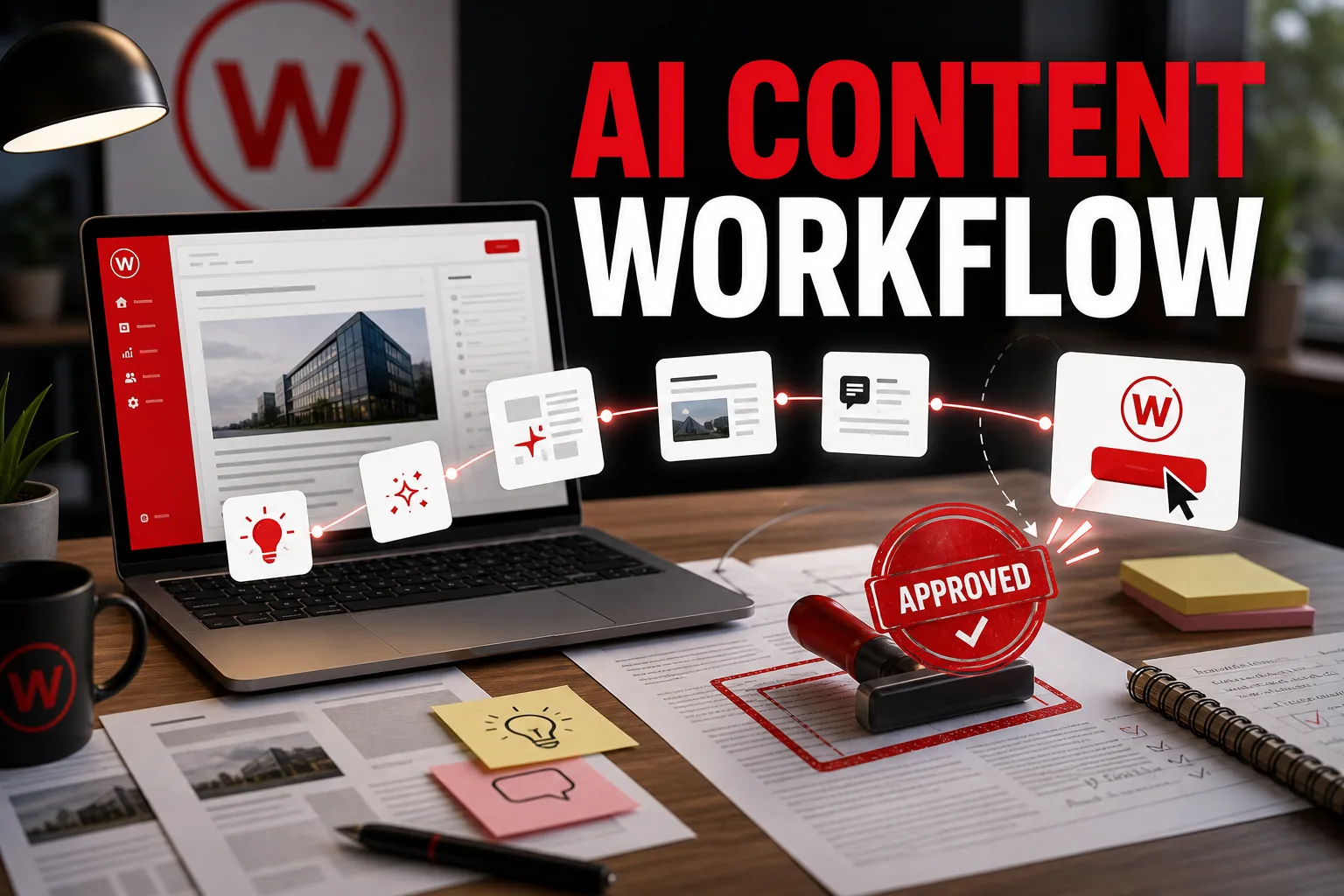
A simple six-step content pipeline
A practical version can be kept small:
- collect topics from customer questions, Search Console and sales conversations
- group topics by intent and business relevance
- create a structured brief
- generate or assist with a first draft
- review facts, positioning, tone and calls to action
- publish, distribute and measure
The workflow should be boring enough to repeat. That is a feature, not a weakness.
Where AI helps most
AI is useful where the task is repetitive and the input can be structured. Examples include clustering similar keywords, generating outline alternatives, turning one long article into social posts, creating first-draft meta descriptions, extracting reusable points from internal documents, and converting a finished article into several formats.
It is less useful when the source material is weak. If your positioning is unclear, automating content production can simply produce more unclear content faster.
That is why it makes sense to check the website and positioning before scaling production. The free Websiteli Market Scan can identify website gaps, positioning issues and content opportunities from one public URL.
What should stay human
A strong pipeline has deliberate approval points. Human review is especially important for:
- factual and numerical claims
- legal or compliance-sensitive wording
- pricing and commercial promises
- customer examples and testimonials
- brand tone
- final prioritisation
The goal is not to remove humans. It is to remove repetitive work around the decisions that actually need humans.
How to structure the inputs
The quality of an AI content pipeline depends heavily on the quality of the brief. A useful brief should include the target audience, search intent, primary topic, business goal, proof points, internal links, desired CTA and claims that must not be invented.
Once those fields are consistent, AI output becomes much easier to review.
What to measure
Do not optimise the pipeline for the number of posts generated. Measure whether the content creates useful business outcomes.
Useful metrics include impressions, organic clicks, qualified landing-page visits, newsletter signups, contact submissions and assisted conversions. Search Console is particularly useful for finding queries where you already receive impressions but rank too low or receive no clicks.
That is exactly the kind of gap worth turning into a focused article instead of publishing another generic topic.
A sensible starting setup
For most small businesses, one article per week with a clear workflow is better than daily AI-generated content. Start with a single content type, one target audience and one primary distribution channel. Improve the process after you have enough data to see what performs.
If you need the technical implementation behind the workflow, see Websiteli's AI and automation services or contact Websiteli.