
Article summary
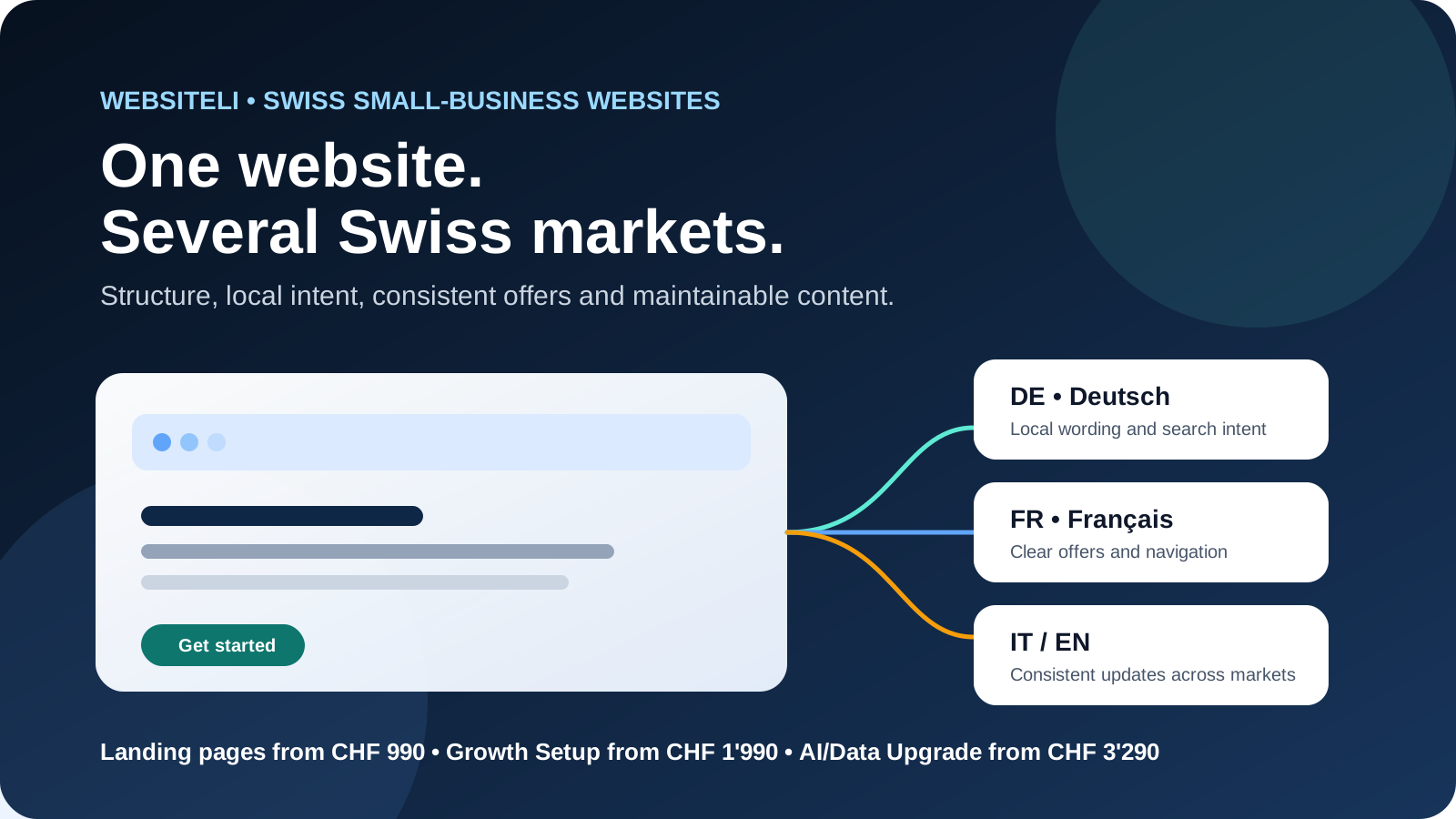
- A multilingual website should be designed around customer markets and search intent, not around translating every existing page automatically.
- Swiss small businesses should prioritise the languages that match real demand, service capacity and geographic reach.
- Each language version needs clear navigation, equivalent offers, local wording and consistent calls to action.
- Machine translation can accelerate drafting, but important service pages, legal text and conversion copy need human review.
- The best multilingual setup is the one the business can maintain accurately over time.
Key takeaways
- Choose website languages based on customers, regions and service capability.
- Use one clear URL structure per language and keep navigation predictable.
- Adapt wording to local search intent instead of translating keywords literally.
- Keep prices, opening hours, forms and legal information consistent across languages.
- Use AI to support translation workflows, but keep human review for trust-critical content.
The short answer
A multilingual website can be one of the strongest growth assets for a Swiss small business.
It can help a company serve German-speaking, French-speaking, Italian-speaking and international customers from one professional platform. It can also create confusion very quickly when pages are translated without a plan.
The biggest mistake is treating multilingual content as a copy-and-paste task. A strong setup starts with customer demand, service capacity, local search intent and a realistic maintenance process.
Start with markets, not languages
Do not add a language because Switzerland has several official languages. Add it because it supports a real business goal.
Ask:
- Which regions already generate enquiries?
- Which languages does the team confidently support?
- Are customers searching locally in a different language?
- Can the business deliver the same service quality in that market?
- Which pages are essential before promotion starts?
A Zurich consultant may need German and English. A hospitality business near a tourist destination may need German, French and English. A company serving Ticino may need Italian before adding another international language.
The right answer depends on the business, not on a fixed template.
Build one clear structure
Visitors should always know which language they are viewing and how to switch.
A clean structure usually gives each language its own path, such as:
- /de/
- /fr/
- /it/
- /en/
Each version should keep the same basic navigation logic. Services, pricing, contact details and calls to action should be easy to find in every supported language.
Do not send visitors back to the homepage when they switch language. Keep them on the equivalent page whenever possible.
Translate meaning, not just words
Literal translation often creates awkward business copy.
Service names, calls to action and customer questions can differ across regions. The phrase people use in German may not be the phrase they search in French. A direct translation may be grammatically correct and commercially weak.
Good multilingual content adapts:
- search wording;
- local examples;
- tone and formality;
- service terminology;
- trust signals;
- calls to action.
The offer should stay consistent, but the language should feel natural to the reader.
Keep conversion paths consistent
A multilingual website should not create different promises by accident.
Check that every language version shows the same:
- prices and package scope;
- opening hours;
- service areas;
- contact details;
- booking availability;
- legal information;
- form questions;
- confirmation messages.
This is especially important when a site promotes fixed packages. Websiteli offers landing pages from CHF 990, Growth Setup from CHF 1'990 and AI/Data Upgrade from CHF 3'290. These details should remain consistent everywhere they appear.
Use AI as a translation assistant
AI can speed up multilingual work.
It can create first drafts, compare versions, flag missing sections, standardise terminology and help maintain reusable translation glossaries.
It should not be the final reviewer for important content.
Human review matters most for:
- homepage positioning;
- service descriptions;
- pricing;
- legal and privacy information;
- medical, financial or regulated claims;
- calls to action;
- customer emails and form confirmations.
The practical model is AI-assisted drafting with human approval.
Plan maintenance before launch
Every extra language multiplies maintenance work.
When a price changes, every relevant page must change. When a service is renamed, navigation, forms, metadata and internal links may also need updates.
Create a simple content ownership process:
1. Record which pages exist in each language. 2. Keep approved terms in a shared glossary. 3. Mark trust-critical pages for human review. 4. Update all versions from one change request. 5. Review important pages quarterly.
The goal is not perfect translation at launch. The goal is a reliable system that stays accurate.
What to launch first
A small business does not need to translate everything immediately.
Start with:
- homepage;
- core service pages;
- pricing or package page;
- about or trust page;
- contact page;
- essential FAQs;
- legal and privacy pages;
- confirmation messages.
Add blog archives, long resource pages and lower-priority content after the main customer journey works well.
A practical multilingual website plan
A sensible rollout can look like this:
Phase one: foundation
Launch the primary language with strong structure, analytics and conversion paths.
Phase two: highest-value second language
Translate the most important pages and adapt them to local search intent.
Phase three: automation and governance
Create a glossary, update workflow and review process. Use AI to support drafts and comparisons.
Phase four: growth
Add local landing pages, campaigns, resources and automation when demand justifies them.
Final takeaway
A multilingual website is not successful because it has many flags in the header.
It is successful when customers in each target market understand the offer, trust the business and can take the next step without confusion.
For Swiss small businesses, the best multilingual strategy is focused, consistent and maintainable.
Websiteli builds multilingual business websites, landing pages, automation and practical AI solutions. Landing pages start from CHF 990, Growth Setup from CHF 1'990 and AI/Data Upgrade from CHF 3'290.
Treat each language as a real search and conversion experience
A multilingual website should do more than translate visible text. Each language version needs a stable URL, localized metadata, appropriate hreflang signals and copy that matches how people in that market search and make decisions.
See Websiteli's multilingual website service or start with the business website service if the overall site structure also needs work.