
Article summary
- Visitors decide quickly whether a website is worth their attention, so the offer and next step must be clear immediately.
- Trust signals, contact details, proof, and professional design help people feel safe before they contact a business.
- Mobile usability and speed affect whether visitors stay, especially because DataReportal reports that 96.2% of internet users use mobile phones to go online at least some of the time.
- Search still matters: StatCounter reported Google at 91.27% worldwide search share in June 2026.
- The complete Website Success Report remains a lead magnet for readers who want the full checklist and research pack.
Key takeaways
- Answer what you offer, who it is for, and what to do next within seconds.
- Treat speed as a business issue because slow pages lose visitors before they can convert.
- Design and test mobile first.
- Use structured, helpful content for SEO, AI search, and real customer questions.
- Accessibility, forms, and calls to action are conversion factors.
- Use the report CTA to turn high-intent readers into subscribers.
The short answer
Some business websites get customers because they make the next step obvious. They explain the offer quickly, build trust, load fast, work on mobile, and make it easy to contact the business. Nielsen Norman Group explains that users often leave pages within 10-20 seconds unless the value proposition is clear quickly. (Nielsen Norman Group).
Executive summary
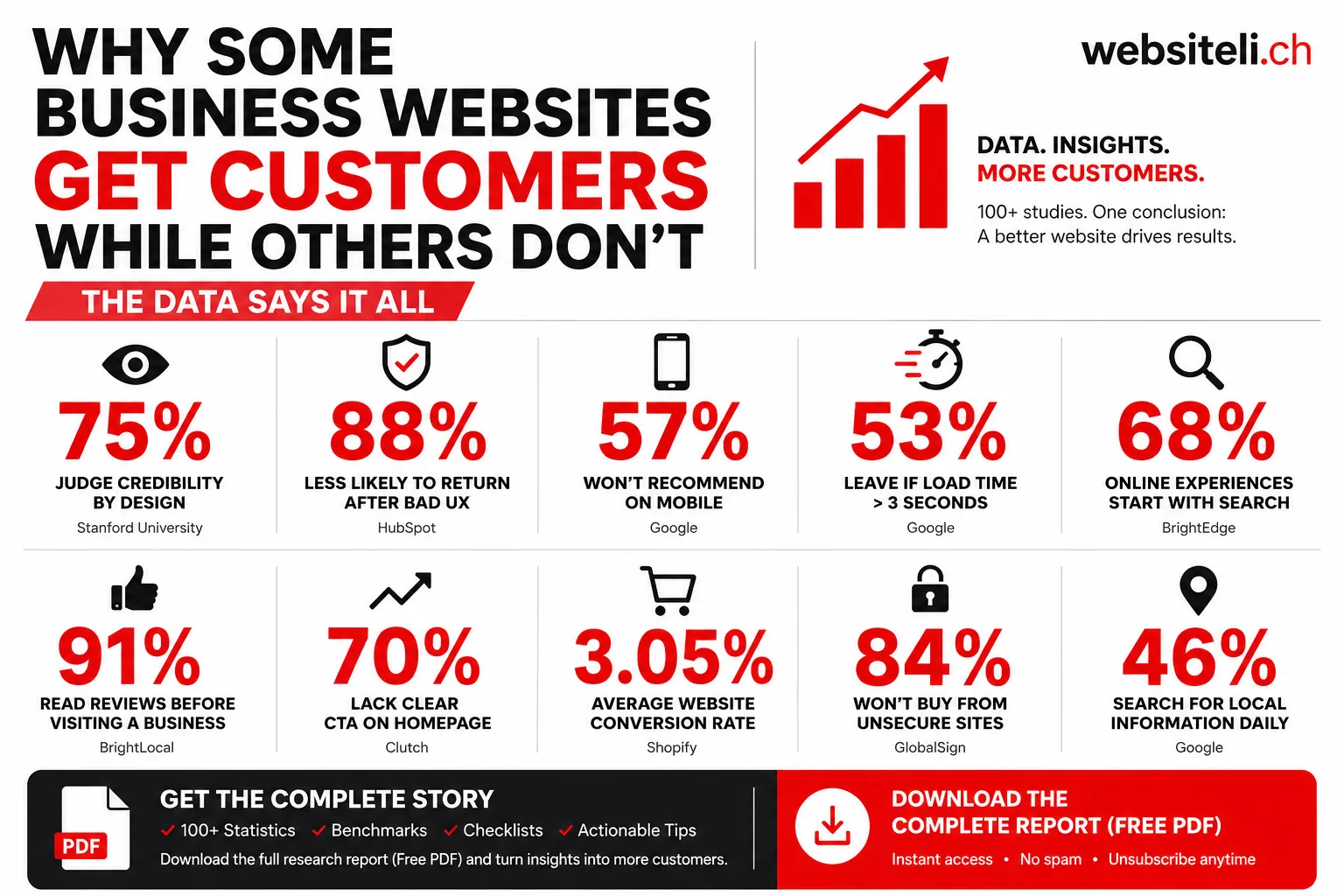
- Google found that 53% of mobile site visits are abandoned when pages take longer than three seconds to load (Think with Google).
- DataReportal reported 6.12 billion internet users at the start of April 2026, equal to 73.8% of the world's population, and 96.2% of internet users use a mobile phone to go online at least some of the time (DataReportal).
- StatCounter reported Google at 91.27% worldwide search engine market share in June 2026 (StatCounter).
- WebAIM found detectable WCAG failures on 95.9% of the top one million home pages in 2026 (WebAIM).
- Baymard reports an average documented cart abandonment rate of 70.22% (Baymard Institute).
The verified data points in this guide are practical: Google found that 53% of mobile site visits are abandoned after more than three seconds; DataReportal reported 6.12 billion internet users at the start of April 2026; WebAIM found detectable WCAG failures on 95.9% of the top one million home pages in 2026; Baymard reports an average cart abandonment rate of 70.22%.
1. Clear websites keep attention longer
Visitors usually ask: what do you offer, is it relevant to me, and what should I do next? A stronger website answers those questions in plain language before the visitor has to hunt.
2. Trust is built before the first conversation
Stanford's Web Credibility Guidelines emphasize clear contact information, a real organization behind the site, easy verification, and professional design. Small businesses need these signals because many visitors do not know the brand yet. (Stanford Web Credibility Research).
3. Mobile experience and speed shape the journey
Mobile is central to discovery and buying. DataReportal reports that 96.2% of internet users use a mobile phone to go online at least some of the time, and Google reports that bounce probability rises 123% as mobile load time goes from one to ten seconds. HTTP Archive found the median 2025 home page was 2.86 MB on desktop and 2.56 MB on mobile, with images taking the largest share of bytes. (Think with Google, HTTP Archive Web Almanac).
4. Search visibility still matters, but discovery is changing
Google held 91.27% worldwide search engine market share in June 2026. Search is also changing through AI summaries and answer engines, so the safest response is clear, specific, helpful content that answers real customer questions and uses sensible structure. (Google Search Central).
5. Accessibility is a customer experience issue
Accessibility removes friction for more people. WebAIM's 2026 Million found detectable WCAG failures on 95.9% of home pages. Low contrast, missing alt text, unlabeled forms, empty links, and unclear buttons are not only compliance issues; they make conversion harder.
6. Website builders are common, but strategy still matters
W3Techs reported in July 2026 that WordPress is used by 41.5% of all websites and 59.2% of websites with a known CMS. Tools are common, but tools do not replace strategy. A website still needs message, structure, performance, trust, SEO, and conversion planning. (W3Techs).
7. Forms and checkout flows lose people when they create friction
Baymard reports an average documented cart abandonment rate of 70.22%. Service businesses can lose people in the same way through long contact forms, unclear pricing, surprise steps, weak confirmation messages, or missing trust near the form.
The Websiteli website success checklist
Use this quick checklist to review your own website.
- Can a visitor understand your offer quickly?
- Is the main call to action visible on mobile and desktop?
- Are contact details and trust signals easy to find?
- Do important pages load quickly and use compressed images?
- Does each important service have its own useful content?
- Are forms short, labeled, and clear about what happens next?
Download the complete research report
This article is the public version. The complete Websiteli Website Success Report includes the deeper source pack, a full audit checklist, and practical prompts for improving your website.
Conclusion
Some websites get customers because they make it easy to understand, trust, and contact the business. Others lose customers through doubt, delay, confusion, or friction. The fix is not decoration; it is clarity, speed, trust, accessibility, search structure, and a better next step.
Connect search visibility to a clear next step
A page can rank and still fail to generate enquiries if the visitor cannot quickly understand the offer, see proof or choose a next step. Search visibility and conversion should therefore be improved together rather than as separate projects.
Websiteli's business website service focuses on that full path, while lead generation automation can connect forms, tracking, routing and follow-up after the website starts producing interest.
Free report
Get the Free Website Success Report
Research-backed insights, practical checklists, and website statistics delivered to your inbox.
Share
References
- Cart Abandonment Rate Statistics Baymard Institute
- Global Digital Overview DataReportal
- Creating helpful, reliable, people-first content Google Search Central
- Page Weight 2025 HTTP Archive Web Almanac
- How Long Do Users Stay on Web Pages? Nielsen Norman Group
- Web Credibility Guidelines Stanford Web Credibility Research
- Search Engine Market Share Worldwide StatCounter
- Mobile Page Speed New Industry Benchmarks Think with Google
- Mobile Site Speed Playbook Think with Google
- Usage Statistics of WordPress W3Techs
- The WebAIM Million WebAIM