
Article summary
- Discover 10 essential business website features for 2026 to improve trust, usability, and lead generation.
- A modern business website should do more than look good. In 2026, it needs to load fast, guide visitors clearly, build trust, and make it easy to take action. Here are 10 business website features every small business should plan for.
- Audience: Small business owners.
- Attention
- A business website in 2026 has one job above all: help people understand your business quickly and take the next step with confidence. That sounds simple, but many websites still miss the basics. They look nice on the surface, yet fail when it comes to clarity, speed, trust, and action.
- Important point: Use large, clear text.
- Important point: Keep buttons easy to tap.
- Important point: Avoid oversized pop-ups.
Key takeaways
- Focus on attention.
- Focus on interest.
- Focus on desire.
- Focus on action.
- Use large, clear text
- Keep buttons easy to tap
- Avoid oversized pop-ups
Attention
A business website in 2026 has one job above all: help people understand your business quickly and take the next step with confidence. That sounds simple, but many websites still miss the basics. They look nice on the surface, yet fail when it comes to clarity, speed, trust, and action.
If you are planning a new site or reviewing your current one, the right business website features can make a real difference. Not because they are trendy, but because they support how people actually browse today. Most visitors scan fast, use mobile devices, and expect a smooth experience. If your website makes them work too hard, they leave.
That is why a practical website checklist matters. Good website planning is not only about design choices. It is about building a site that explains your offer, builds trust, and makes contact easy.
Interest
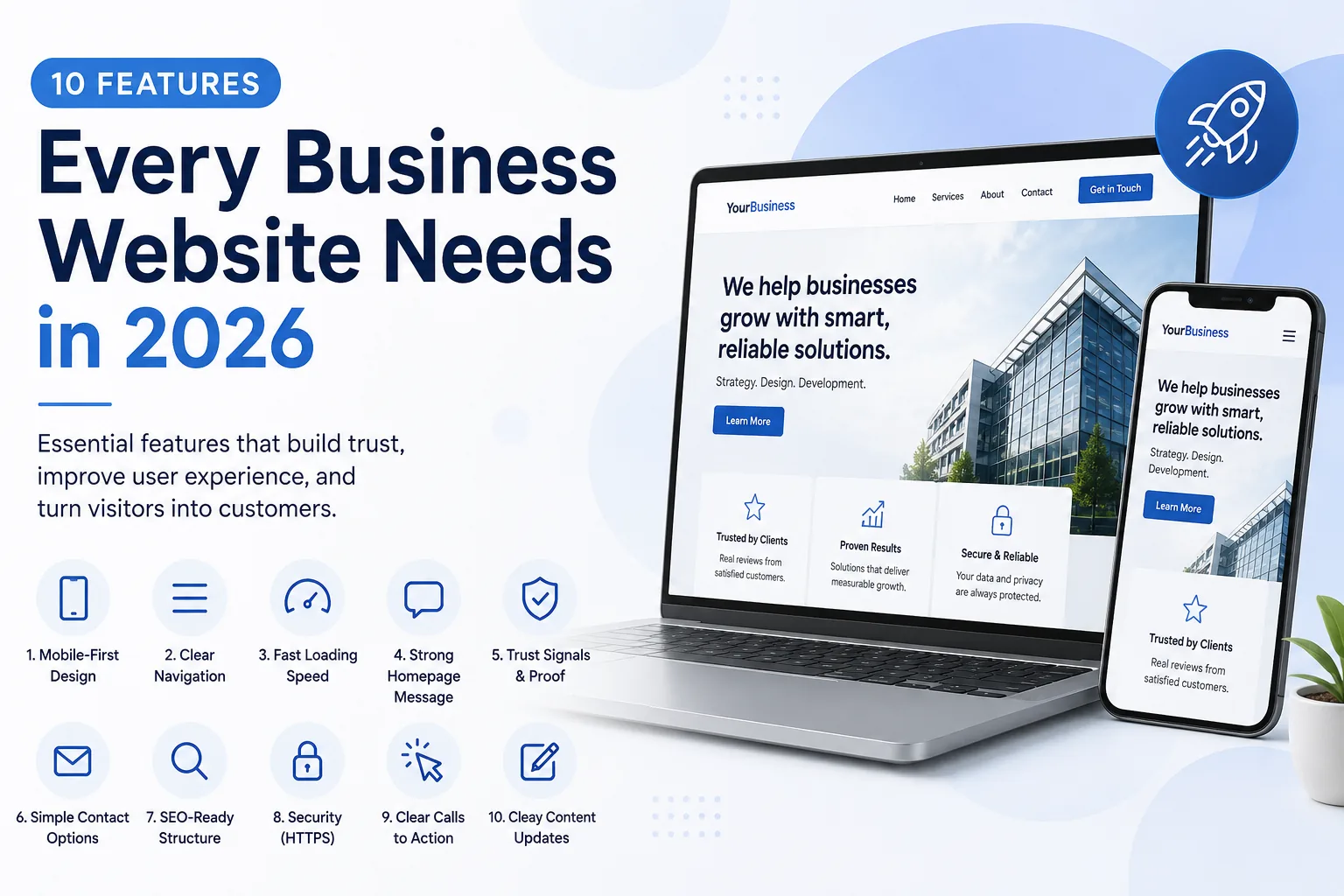
Here are the 10 features every business website needs in 2026.
1. Mobile-first design
Mobile-first website design is no longer optional. For many small businesses, most visitors arrive on a phone. Your site should be readable, tappable, and fast on smaller screens before anything else.
Practical advice:
- Use large, clear text
- Keep buttons easy to tap
- Avoid oversized pop-ups
- Test key pages on a phone, not just a desktop
If your website looks fine on a laptop but feels cramped on mobile, it needs work. A strong mobile-first approach is one of the most important business website features today.
2. Clear navigation
Visitors should know where to go within a few seconds. Clear navigation helps them find services, pricing, about information, and contact details without frustration.
Keep your menu simple:
- Home
- Services
- About
- Contact
- Optional: FAQ, Blog, Portfolio
Do not overload the menu with too many items. Good website planning keeps the path short and obvious.
3. Fast loading speed
Speed is part of the experience. A slow website feels unfinished and can hurt trust. People expect pages to load quickly, especially on mobile networks.
Ways to improve speed:
- Compress images
- Remove unnecessary plugins or scripts
- Use modern file formats
- Keep layouts clean and efficient
Fast loading speed is both a usability feature and a design decision. It supports better website design and a smoother customer journey.
4. Strong homepage message
Your homepage should answer three questions immediately:
- What do you do?
- Who is it for?
- Why should I care?
A strong homepage message keeps visitors from guessing. It should be clear, specific, and focused on the customer’s problem or goal.
Example structure:
- Short headline
- One sentence explaining your offer
- One clear action button
This is one of the simplest business website features to improve, and one of the most important.
5. Trust signals and proof
People want reassurance before they contact a business. Trust signals help reduce hesitation.
Useful trust signals include:
- Reviews or testimonials
- Certifications or memberships
- Real photos of your business or team
- Clear contact details
- Privacy and legal pages
Do not overdo it. A few believable trust signals are better than a wall of generic claims. In website design, trust is not decoration; it is part of conversion.
6. Simple contact options
If someone is ready to reach out, the process should be easy. A small business website should never hide the contact path.
Good contact options include:
- A short contact form
- Click-to-call on mobile
- Email link
- Visible contact page in the main menu
Also consider where the contact options appear. They should be available on the homepage, service pages, and footer. If contact is hard to find, you lose leads.
7. SEO-ready structure
A website can look great and still be hard for search engines to understand. That is why SEO-ready structure belongs on every website checklist.
An SEO-ready site usually includes:
- One clear H1 per page
- Logical H2 and H3 sections
- Descriptive page titles
- Helpful internal links
- Text that matches real search intent
This does not mean writing for robots. It means organizing content in a way that helps both visitors and search engines.
8. Secure website setup
Security is not only a technical issue. It affects trust.
A secure website should have:
- HTTPS
- Updated software and plugins
- Secure forms
- Spam protection where needed
- Regular backups
If your website still shows security warnings or outdated elements, visitors may hesitate. Secure setup is one of the business website features that quietly supports everything else.
9. Calls to action that guide visitors
A website should not leave people wondering what to do next. Clear calls to action help guide the journey.
Examples:
- Request a quote
- Book a call
- Send a message
- Download a guide
- Join the newsletter
Place calls to action naturally across the site. They should match the page content and the visitor’s stage of interest. On a service page, the action can be direct. On a blog post, it can be softer and more educational.
10. Easy content updates
A website is not a one-time project. It needs to stay current.
If you cannot update text, images, FAQs, or service details easily, your site can become outdated fast. That creates confusion and weakens trust.
Choose a system that allows simple edits for:
- Opening hours
- Service changes
- New blog posts
- Team updates
- Seasonal offers
Easy updates support long-term website planning and reduce dependence on constant developer help.
Desire
The best business website features work together. Mobile-first design helps visitors stay. Clear navigation helps them move. Fast speed keeps them engaged. A strong homepage message helps them understand. Trust signals help them believe. Contact options help them act.
That is the real value of a well-planned website: it removes friction.
For small business owners, this matters even more. You do not need a huge site. You need the right site. A focused, practical website with the right structure can support enquiries, save time, and make your business easier to understand.
If you are starting from scratch, a good website checklist can keep decisions simple. If you already have a site, use this list to find gaps. Ask yourself:
- Can a visitor understand my offer in seconds?
- Does the site work well on mobile?
- Is the contact path obvious?
- Is the content current?
- Does the site feel trustworthy?
If you answered “no” to any of these, you have a clear place to improve.
For more guidance on building a practical site for a small company, see our internal guide on small-business-website.
Action
Use this final website checklist for business owners in 2026:
- Mobile-first design
- Clear navigation
- Fast loading speed
- Strong homepage message
- Trust signals and proof
- Simple contact options
- SEO-ready structure
- Secure setup
- Clear calls to action
- Easy content updates
If your current site misses several items, you do not need to rebuild everything at once. Start with the pages that matter most, then improve the rest step by step. Good website design is often about removing confusion, not adding complexity.
The smartest next move is to review your website against this list and plan the upgrades that will help visitors move forward with less effort.