
Article summary
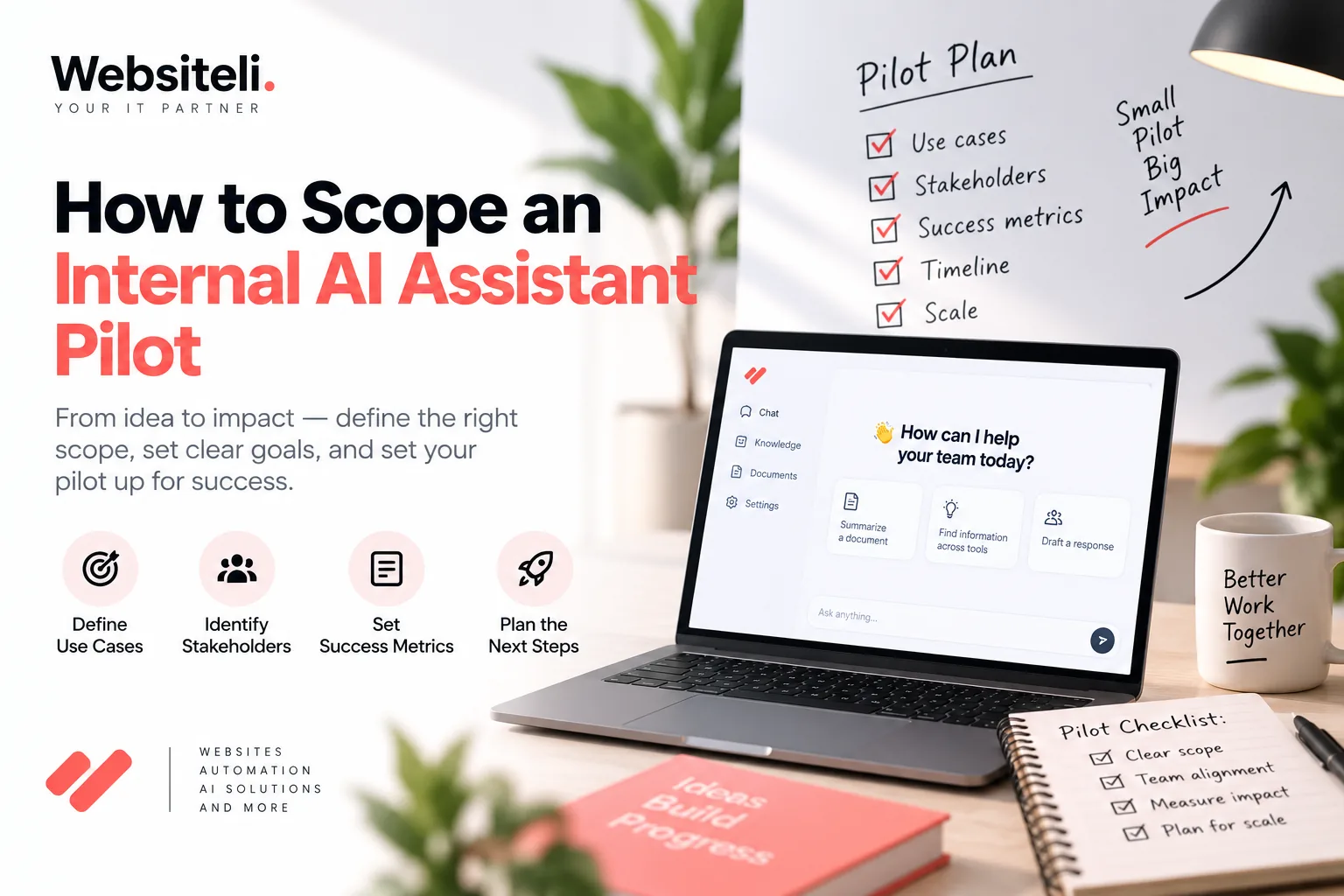
- A successful pilot starts with one repeatable task, trusted sources, clear permissions and a measurable decision about whether to expand.
- Name the first user group, the source systems and the information that must remain out of scope. Decide whether the assistant may only retrieve information or may also draft, send, edit or publish. For Swiss and European businesses, permissions, personal data and confidential material should be addressed before documents are indexed, not after the first demonstration.
- Write down what a useful result means. Criteria can include finding the current source, citing it, refusing unsupported questions, respecting role-based access and handing sensitive cases to a person. Also define unacceptable failures. A pilot is easier to judge when the team agrees on evidence before seeing polished outputs.
- Expand only when the original use case is reliable and the next use case has its own owner, sources and acceptance criteria. Improve the pilot when failures are fixable through cleaner documents, better retrieval or clearer instructions. Stop when the task is too rare, the source quality is poor, the risk is disproportionate or a simpler search or workflow tool solves the problem better.
Key takeaways
- Start with a task that happens often, consumes time and can be checked against an authoritative source. Good pilot candidates include finding an approved procedure, preparing a standard briefing or answering recurring internal product questions. Avoid broad goals such as ‘answer anything about the company,’ because they hide missing documents, unclear ownership and conflicting expectations.
- Use the smallest document collection and integration set that can complete the chosen task. Clean versions, clear titles and named owners usually matter more than adding more files. Keep the interface simple, limit the number of actions and preserve a manual fallback so users can finish their work when the assistant is uncertain.
- Assign a business owner for the workflow, a content owner for each source and a technical owner for the system. Decide who approves access, resolves contradictory documents, reviews failures and authorizes scope changes. Without these roles, a pilot can produce useful demos but no reliable operating process.
- Expand only when the original use case is reliable and the next use case has its own owner, sources and acceptance criteria. Improve the pilot when failures are fixable through cleaner documents, better retrieval or clearer instructions. Stop when the task is too rare, the source quality is poor, the risk is disproportionate or a simpler search or workflow tool solves the problem better.
Choose a narrow task with visible business value
Start with a task that happens often, consumes time and can be checked against an authoritative source. Good pilot candidates include finding an approved procedure, preparing a standard briefing or answering recurring internal product questions. Avoid broad goals such as ‘answer anything about the company,’ because they hide missing documents, unclear ownership and conflicting expectations.
Define users, sources and boundaries
Name the first user group, the source systems and the information that must remain out of scope. Decide whether the assistant may only retrieve information or may also draft, send, edit or publish. For Swiss and European businesses, permissions, personal data and confidential material should be addressed before documents are indexed, not after the first demonstration.
Set success criteria before building
Write down what a useful result means. Criteria can include finding the current source, citing it, refusing unsupported questions, respecting role-based access and handing sensitive cases to a person. Also define unacceptable failures. A pilot is easier to judge when the team agrees on evidence before seeing polished outputs.
Design the smallest workable pilot
Use the smallest document collection and integration set that can complete the chosen task. Clean versions, clear titles and named owners usually matter more than adding more files. Keep the interface simple, limit the number of actions and preserve a manual fallback so users can finish their work when the assistant is uncertain.
Assign ownership and decision rights
Assign a business owner for the workflow, a content owner for each source and a technical owner for the system. Decide who approves access, resolves contradictory documents, reviews failures and authorizes scope changes. Without these roles, a pilot can produce useful demos but no reliable operating process.
Run the pilot with real questions
Test with real users and realistic wording, including incomplete questions, multilingual terms, outdated expressions and cases with no answer. Record the question, retrieved source, response, user decision and any extra verification work. The goal is not to collect only successful examples but to understand where the workflow breaks.
Decide whether to improve, expand or stop
Expand only when the original use case is reliable and the next use case has its own owner, sources and acceptance criteria. Improve the pilot when failures are fixable through cleaner documents, better retrieval or clearer instructions. Stop when the task is too rare, the source quality is poor, the risk is disproportionate or a simpler search or workflow tool solves the problem better.
Internal AI assistants · AI integrations · Business automation · Services and pricing · Contact
Keep the pilot deliberately small
A good pilot should prove one useful workflow before the project expands. Define the users, approved sources, permission boundaries, evaluation questions and failure conditions before adding more documents or teams.
Websiteli can help scope and build a controlled internal AI assistant or RAG chatbot around a real business use case.