
Article summary
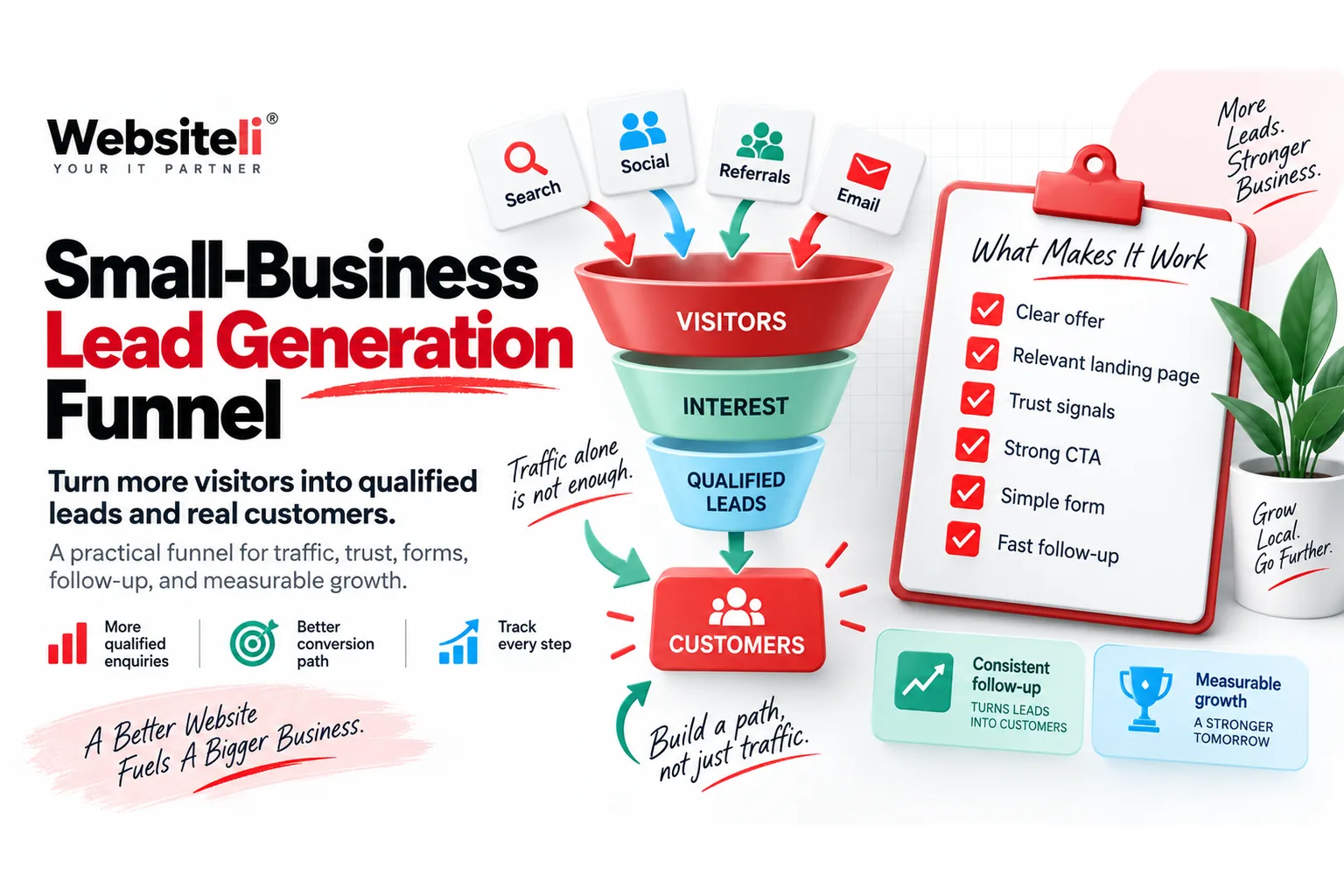
- A lead-generation funnel connects discovery, a relevant landing page, a clear conversion action and a defined follow-up process.
- Search and social traffic should land on a page that continues the promise that caused the click.
- Forms should collect only information that changes routing, preparation or the next step.
- Tracking should measure meaningful actions such as enquiries, bookings and qualified opportunities rather than traffic alone.
- Follow-up speed and ownership are part of the funnel because a submitted form has no business value until someone handles it well.
Key takeaways
- Treat lead generation as an end-to-end customer journey, not a traffic problem.
- Match each traffic source to the most relevant page and next action.
- Remove friction before adding more traffic.
- Define who owns every lead after submission and what happens next.
- Use analytics to find the weakest stage before investing in more acquisition.
Start with the complete funnel, not the traffic source
A useful small-business funnel is simple: search or social → relevant page → clear action → form or booking → follow-up. Each stage should make the next one easier. If traffic arrives on a generic page, the offer is unclear, the form fails or nobody owns the follow-up, the funnel leaks even when the campaign itself looks busy. For Swiss and European SMEs, this is often more valuable to fix than adding another marketing channel.
Step 1: attract the right visitor
Start with intent. Someone searching for a specific service is in a different situation from someone seeing an educational social post for the first time. Use search pages, local service pages, useful articles and social content to attract people whose problem matches what you actually offer. Avoid promising outcomes you cannot prove; the goal is qualified attention, not the highest possible click count.
Step 2: send the visitor to the right landing page
Continue the promise of the source. A visitor who clicked a page about a specific service should not have to decode a broad homepage. A focused landing page should explain the offer, who it is for, what is included, relevant practical information and the next step. Internal links can support visitors who need more context, but the primary path should remain clear.
Step 3: make the next action obvious
Choose one primary conversion action for the page: request a quote, book a consultation, reserve a time, start an enquiry or contact the business. Place it where visitors can find it without searching and use wording that explains what happens after the click. A lower-commitment alternative, such as viewing pricing or reading a related guide, can help people who are not ready to contact you yet.
Step 4: capture enough information to act
A form should ask only for details that help you respond, route or prepare. Name, contact details, service type, location, timing and a short description are often enough. Add budget, files or additional questions only when they genuinely change the next step. Test validation and confirmation on desktop and mobile, and make sure enquiries actually reach the person or system that should receive them.
Step 5: track the conversion path
Measure the stages that matter. Page views are useful context, but the funnel becomes actionable when you can see form submissions, booked calls, quote requests or other meaningful events. Keep campaign parameters consistent and test the conversion event yourself. If possible, connect the website action to the later business outcome so you can distinguish traffic that creates work from traffic that creates useful opportunities.
Step 6: follow up with clear ownership
Decide who receives each lead, how it is acknowledged and what the expected next step is. Simple automation can send confirmations, create CRM records, route by service type or notify the right person, but important decisions should remain understandable and reviewable. A lead can be lost after a technically perfect form if the reply is late, generic or sent to the wrong owner.
Improve the weakest stage before buying more traffic
Review the funnel stage by stage before increasing acquisition spend. If the right people are not arriving, improve targeting and search intent. If visitors arrive but do not act, improve the page and offer. If forms start but fail, reduce friction. If enquiries arrive but rarely become useful conversations, inspect qualification and follow-up. Websiteli can help connect landing pages, business websites, CRM automation and measurement into one maintainable flow.
Business websites · Landing pages · Business automation · CRM automation · Services and pricing · Contact Websiteli
Connect traffic to a measurable lead process
Online lead generation works better when the website, form, source tracking and follow-up are treated as one system. A visitor should understand the offer, know the next step and receive a useful response without the business losing the source of the enquiry.
See Websiteli's lead generation automation service for form routing and follow-up, or business website service if the conversion path itself needs rebuilding.