Article summary
- A customer chatbot serves website visitors, while an internal AI assistant supports employees with approved company information.
- The right choice depends on the bottleneck: repetitive customer questions or time lost finding internal information.
- Both systems need controlled sources, permissions, human escalation and maintenance.
- Start with one narrow use case and measurable success criteria.
Key takeaways
- Choose the user and business problem before choosing technology.
- Keep private documents out of public chatbot knowledge sources.
- Design a clear escalation path for uncertain answers.
- Measure useful outcomes, accuracy and maintenance effort.
The short answer
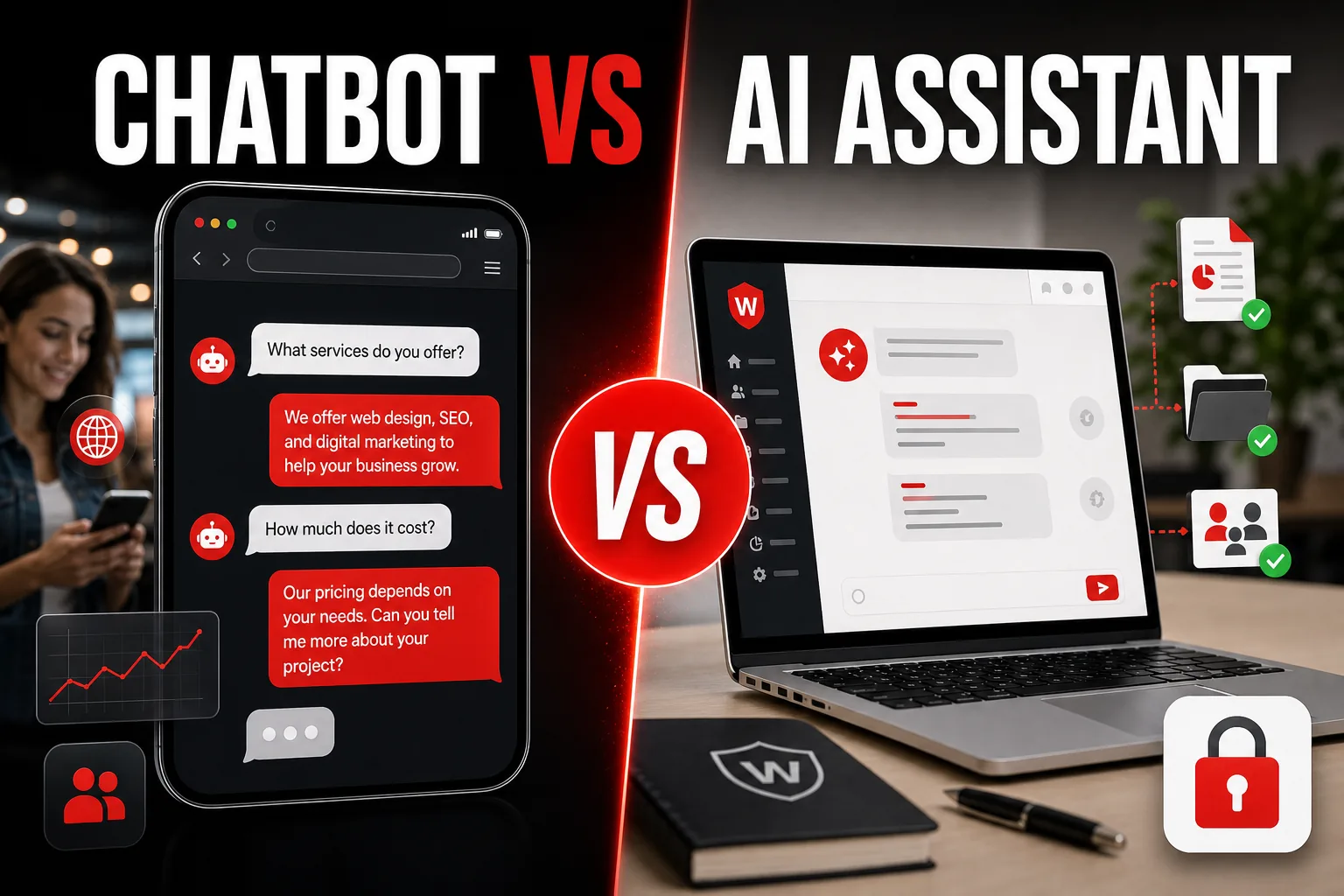
An AI chatbot and an internal AI assistant may look similar, but they serve different people and carry different risks.
A chatbot usually helps customers on a public website. An internal assistant helps employees find, summarise or prepare information from approved business sources. The best first project is the one connected to a clear, repeated business problem.
What a customer-facing AI chatbot does
A customer chatbot can answer common questions, explain services, guide visitors to the right page and collect structured information before a human follows up.
Useful examples include:
- explaining service categories;
- answering opening-hour or process questions;
- helping visitors choose a contact route;
- collecting project requirements;
- handing complex requests to a person.
A chatbot should not invent prices, availability, legal advice or guarantees. It needs a clear fallback when the answer is not supported by an approved source.
What an internal AI assistant does
An internal assistant is designed for employees. It can help people search company documents, summarise procedures, prepare first drafts and retrieve information across approved sources.
Possible use cases include:
- finding the latest internal process;
- summarising a long document;
- preparing a meeting brief;
- comparing approved product or service information;
- drafting an internal response from a controlled knowledge base.
The assistant should respect existing access rights. A user should not receive information they could not access in the original system.
Compare the two before choosing
The most important differences are the user, data and consequence of a wrong answer.
Ask:
- Who will use the system?
- Which sources may it access?
- What happens when it is wrong?
- Which tasks must always go to a person?
- Who owns content updates?
- How will useful outcomes be measured?
Choose based on the bottleneck
Choose a customer chatbot when the team repeatedly answers the same basic enquiries and visitors need faster guidance.
Choose an internal assistant when employees lose time searching documents, recreating summaries or finding the correct internal process.
Data and permission design
Keep public and private information separated.
A public chatbot should use approved website content, service descriptions and frequently asked questions. An internal assistant may connect to documents or systems, but only through explicit permission controls.
For both systems:
- record the source used for important answers;
- restrict publishing or action-taking permissions;
- log failures and unanswered questions;
- remove outdated content;
- test access rules with different user roles.
A practical first version
A first chatbot could answer ten recurring questions and route uncertain enquiries to the contact page.
A first internal assistant could search one approved document collection and provide source-linked answers without changing any business system.
Websiteli's AI assistant services and business automation services can support a controlled implementation. The services and pricing page explains broader project options.
How to measure whether it works
For a chatbot, track useful conversations, completed handovers, unanswered questions and contact conversions.
For an internal assistant, track time saved on a defined task, answer usefulness, source accuracy, permission failures and maintenance effort.
The goal is not to maximise conversations. The goal is to complete the intended task more reliably.
When not to build either
Do not build an AI assistant when the source information is outdated, the process changes every week, nobody owns approvals or a simple search page would solve the problem.
Clean information and a clear workflow often create more value than adding a model too early.
The decision framework
Start with the customer chatbot when external questions are the bottleneck. Start with the internal assistant when employee access to knowledge is the bottleneck.
Keep the scope narrow, preserve human escalation and design the system around information ownership.
Choose the system around the user and the knowledge source
A customer-facing AI chatbot and an internal assistant may use similar retrieval technology, but they serve different users and need different permissions, safeguards and evaluation. If answers must be grounded in a defined document collection, a RAG setup is often the relevant architecture to evaluate.
Compare Websiteli's AI chatbot development, RAG chatbot development and internal AI assistants before choosing the implementation.